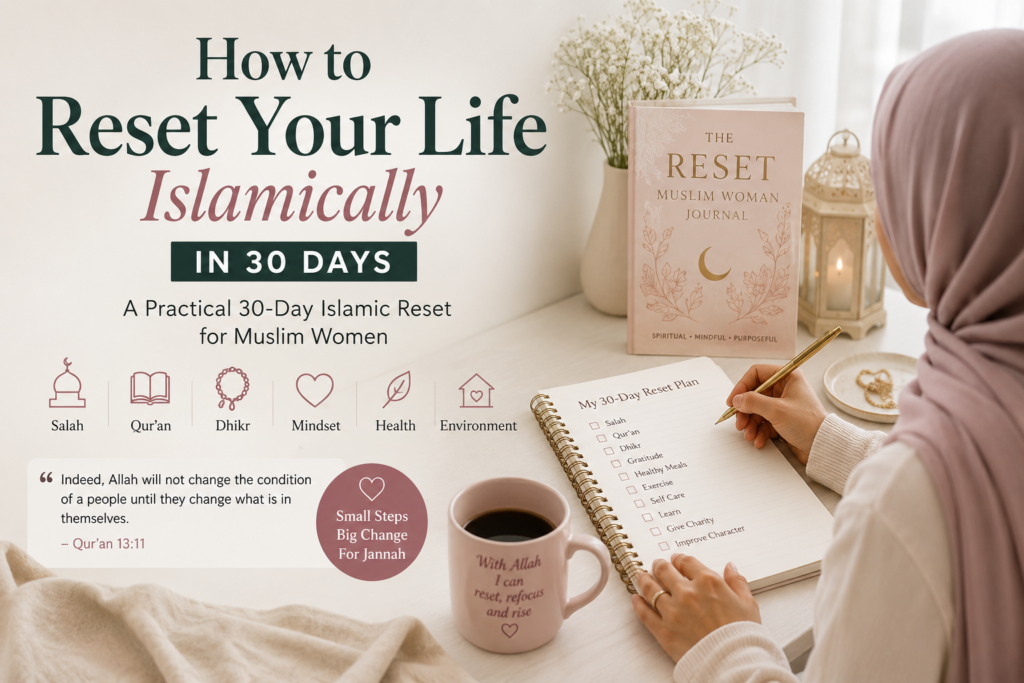
How to Reset Your Life Islamically in 30 Days
A gentle, faith-centered guide for Muslim women who want to rebuild their salah, reconnect with the Qur’an, create better habits, and return to Allah with intention.
Start Your 30-Day ResetIn This Guide
What an Islamic Reset Means Start with Niyyah Audit Your Life Choose Small Deeds Build a Routine Use a Habit Tracker Spiritual, Physical and Emotional Growth When You Slip Up 30-Day Challenge Use The ResetThere comes a point in life when your heart quietly whispers: I need to reset.
Maybe your salah has become rushed. Maybe your Qur’an has been sitting unopened. Maybe your phone takes more of your attention than your soul. Maybe your body feels tired, your mind feels scattered, and your heart feels distant from Allah.
For many Muslim women, this feeling is not about wanting a completely different life. It is about wanting to return to what matters: more peace, more barakah, more discipline, more connection with Allah, and more balance between deen, health, emotions, family, work, studies, and personal growth.
That is where an Islamic reset begins. This guide will show you how to reset your life Islamically in 30 days using simple, faith-centered steps.
What Does It Mean to Reset Your Life Islamically?
To reset your life Islamically means to pause, reflect, and realign your daily life with what pleases Allah.
It is not just about waking up earlier, drinking more water, exercising, or becoming more productive. Those things can be beneficial, but an Islamic reset goes deeper.
- Is my heart connected to Allah?
- Am I praying my salah with care?
- Am I making time for Qur’an and dhikr?
- Are my habits helping my akhirah or distracting me from it?
- Am I treating my body as an amanah?
- Am I using my time in a way that brings barakah?
- Am I becoming the Muslim woman I want to be?
For Muslim women, this reset can be especially meaningful because life can feel full of responsibilities. You may be balancing worship, home, family, marriage, motherhood, work, studies, friendships, health, emotions, and personal goals.
A 30-day Islamic reset gives you space to return to yourself and, most importantly, return to Allah.
Step 1: Begin with Niyyah
Every meaningful change begins with niyyah, your intention. Before you change your routine, fix your sleep schedule, start a habit tracker, or create a 30 day Islamic challenge, ask yourself:
Are you doing it to look productive? To feel in control? To impress people? Or are you doing it to become closer to Allah?
When your intention is clear, even small daily actions become acts of worship. Drinking water can become gratitude for the body Allah gave you. Exercising can become caring for your amanah. Planning your day can become a way to protect your salah. Journaling can become a moment of honest self-accountability.
Before beginning your 30-day Islamic reset, write down:
Step 2: Audit Your Current Life Honestly
You cannot reset what you refuse to look at. An Islamic reset is not about judging yourself harshly. It is about being honest with yourself in front of Allah.
Your Salah
Am I praying all five daily prayers? Do I pray on time? What causes me to delay prayer?
Your Qur’an
How often do I read Qur’an? Do I understand what I read? What distracts me from it?
Your Dhikr
Do I remember Allah throughout my day? Do I make morning and evening adhkar?
Your Emotions
What emotion has been strongest in my heart? Do I turn to Allah with my feelings?
Your Body
Am I sleeping enough, eating well, moving my body, and caring for my energy?
Your Environment
Is my space helping me feel calm? Is my phone distracting me from my iman?
Muslim self improvement should include your worship, emotions, body, routines, environment, and relationship with Allah.
Step 3: Choose Small Consistent Deeds
One mistake many people make during a reset is trying to change everything at once. They decide they will wake up at 5 AM, read one juz daily, exercise every day, eat perfectly, stop social media completely, journal every night, pray every sunnah prayer, and never slip up again.
Then after a few days, they feel exhausted and quit.
Islam teaches us the beauty of consistency. So instead of trying to become a completely new person overnight, choose a few small habits you can repeat.
- Pray salah as soon as the time enters.
- Read five verses of Qur’an daily.
- Make morning adhkar before checking your phone.
- Drink more water.
- Write one thing you are grateful for.
- Walk for ten minutes.
- Make istighfar 100 times.
- Sleep 30 minutes earlier.
- Reduce social media before bed.
Small habits may look simple, but they reshape your identity over time. A Muslim woman who protects small deeds becomes a woman of consistency.
Step 4: Build a 30-Day Islamic Routine
Once you have chosen your habits, place them into a simple daily routine. Your routine does not need to be complicated. It should support your salah, energy, emotional wellbeing, and relationship with Allah.
Morning
- Wake up and say Alhamdulillah.
- Pray Fajr.
- Make morning adhkar.
- Read or listen to Qur’an.
- Set your intention for the day.
- Plan your top priorities.
- Eat or drink something nourishing.
Midday
- Protect Dhuhr prayer.
- Take a short break from your phone.
- Make du’a between tasks.
- Check in with your energy.
- Eat a balanced meal.
- Move your body, even lightly.
Evening
- Pray Maghrib and Isha.
- Make evening adhkar.
- Reflect on your emotions.
- Spend time away from unnecessary scrolling.
- Prepare for the next day.
- Make du’a before sleeping.
This is the heart of a 30 day Islamic challenge: not perfection, but daily return.
Step 5: Use an Islamic Habit Tracker
An Islamic habit tracker helps you see your progress clearly. Many Muslim women struggle not because they lack sincerity, but because they lack structure. A tracker gives your intentions a place to live.
- Fajr
- Dhuhr
- Asr
- Maghrib
- Isha
- Morning adhkar
- Evening adhkar
- Qur’an reading
- Gratitude
- Du’a
- Exercise
- Meals
- Water
- Sleep
- Social media limits
- Daily reflection
Tracking is not about shaming yourself. It is about noticing patterns. If you keep missing Fajr, you may need to sleep earlier. If you feel emotionally drained, you may need less screen time. If you are inconsistent with Qur’an, you may need a smaller daily goal.
Step 6: Include Spiritual, Physical, and Emotional Growth
A true Islamic reset is holistic. You are not only a soul. You are not only a body. You are not only emotions. You are a whole person created by Allah.
Spiritual Growth
Salah, Qur’an, dhikr, du’a, tawbah, Sunnah habits, gratitude, and sadaqah.
Physical Growth
Sleep, movement, hydration, balanced meals, rest, and reducing harmful habits.
Emotional Growth
Naming your feelings, responding with sabr, making du’a, and speaking to yourself with mercy.
Muslim self improvement should not make you harsher toward yourself. It should make you more sincere, more disciplined, and more hopeful in Allah’s mercy.
Step 7: Have a Plan for Slip-Ups
You will slip up. You may miss a habit. You may delay a prayer. You may scroll too much. You may lose motivation. You may feel like you are back at the beginning.
But a slip-up is not the end of your reset. The danger is not falling. The danger is believing you should not get back up.
- Make istighfar.
- Ask what triggered the slip.
- Renew your niyyah.
- Choose one small habit to restart today.
- Do not overcompensate.
- Move forward with hope.
Your reset is not ruined because of one difficult day. Every day is another chance to return to Allah.
A Simple 30-Day Islamic Challenge for Muslim Women
Week 1: Return to Awareness
- Track your salah.
- Write your niyyah.
- Begin morning and evening adhkar.
- Reduce one distraction.
- Journal your emotions.
- Make daily istighfar.
- Reflect on your relationship with Allah.
Week 2: Build Consistency
- Pray on time.
- Read Qur’an daily.
- Drink enough water.
- Walk or move your body.
- Practice gratitude.
- Learn one hadith.
- Give sadaqah.
Week 3: Deepen Your Worship
- Improve khushu in salah.
- Recite Ayatul Kursi.
- Learn names of Allah.
- Make longer du’a.
- Fast one day if you are able.
- Listen to Qur’an.
- Add a Sunnah prayer.
Week 4: Strengthen Your Identity
- Reflect on your progress.
- Replace one bad habit.
- Spend time in nature.
- Do mindful dhikr.
- Make du’a for the ummah.
- Review your routine.
- Write your long-term commitment.
By the end of 30 days, you may not be perfect. But you will be more aware, more connected, and more intentional. That is a beautiful beginning.
Final Thoughts
Learning how to reset your life Islamically is not about becoming flawless in 30 days. It is about returning to Allah with honesty.
It is about rebuilding your salah. It is about opening the Qur’an again. It is about remembering Allah in ordinary moments. It is about caring for your body as an amanah. It is about managing your time with purpose. It is about becoming a Muslim woman whose daily life reflects iman, gratitude, and sincerity.
Ready to Begin Your Own Islamic Reset?
The Reset is a 30-day Islamic habits workbook created to help Muslim women rebuild consistency in salah, dhikr, Qur’an, gratitude, routines, self-reflection, emotional awareness, and mindful living.
Use The Reset as your guided 30-day workbook and begin your journey back to a more intentional, faith-centered life — one day at a time.
Get The Reset on AmazonFrequently Asked Questions
What is an Islamic reset?
An Islamic reset is a period of intentional reflection and habit-building where you realign your daily life with Allah, salah, Qur’an, dhikr, gratitude, and better routines.
Is this 30-day reset only for Muslim women?
The principles can benefit any Muslim, but this guide is written especially for Muslim women who want a gentle, faith-centered way to rebuild structure, spiritual connection, and daily habits.
What should I track during a 30-day Islamic challenge?
You can track salah, Qur’an, morning and evening adhkar, gratitude, du’a, exercise, meals, water, sleep, screen time, and daily emotional reflection.
What if I miss a day?
Make istighfar, renew your niyyah, reflect on what happened, and restart with one small habit. A missed day does not mean your reset has failed.