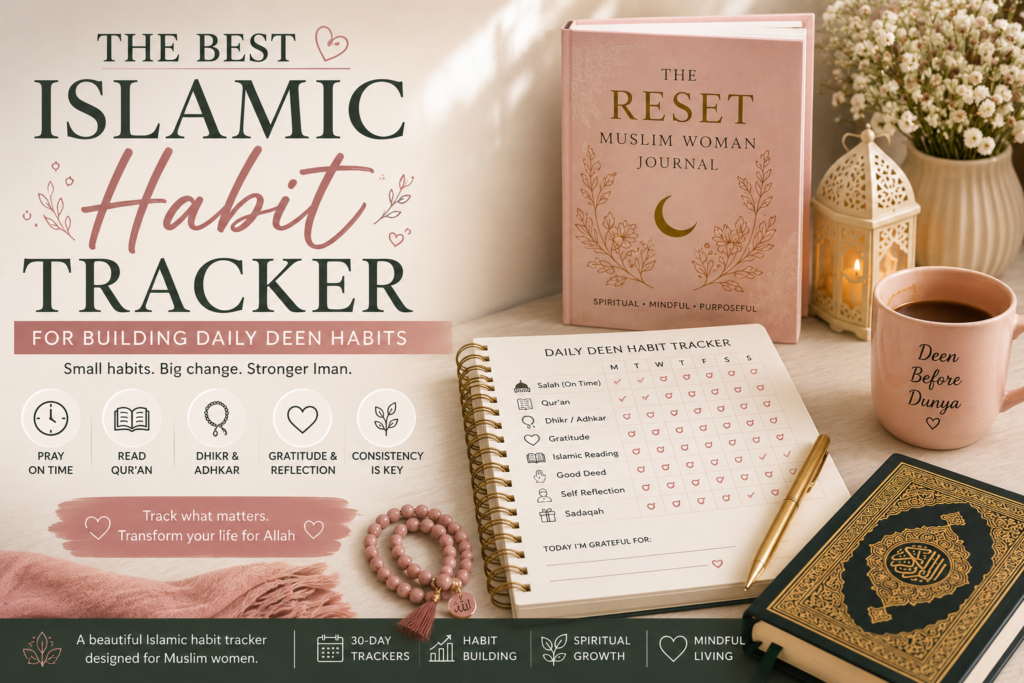
The Best Islamic Habit Tracker for Building Daily Deen Habits
A practical guide for Muslim women who want to track salah, Qur’an, dhikr, gratitude, routines, and personal growth without feeling overwhelmed or guilty.
Start Your Islamic Habit JourneyBuilding better habits as a Muslim woman is not only about becoming more organized. It is about becoming more intentional with the life, time, body, and heart Allah has entrusted to you.
An Islamic habit tracker helps you turn good intentions into visible daily action. It gives your salah, Qur’an, dhikr, gratitude, health, emotional reflection, and routine-building a simple place to live. Instead of relying on motivation alone, you create a gentle system that reminds you where you are growing and where you need support.
For Muslim women balancing worship, family, home, studies, work, marriage, motherhood, emotions, health, and personal goals, a habit tracker can be more than a planner. It can become a tool for muhasabah, self-accountability, and returning to Allah one small deed at a time.
What Is an Islamic Habit Tracker?
An Islamic habit tracker is a simple tool that helps you monitor habits connected to your deen, character, wellbeing, and daily routine. Unlike a general habit tracker, it is built around the idea that your day belongs to Allah and your habits should bring you closer to Him.
A Muslim habit tracker may include worship habits such as salah, Qur’an, dhikr, du’a, and sadaqah, but it can also include lifestyle habits that support worship, such as sleep, movement, hydration, meal planning, screen-time boundaries, emotional check-ins, and gratitude.
It tracks worship
Salah, Qur’an, adhkar, du’a, istighfar, Sunnah habits, charity, and spiritual reflection.
It supports your lifestyle
Sleep, meals, movement, water, screen time, emotional awareness, and routines that protect your energy.
The goal is not to create a life that looks perfect on paper. The goal is to become more aware of your patterns and make small changes that help your heart, body, and schedule support your worship.
Why Muslim Women Benefit from Habit Tracking
Many Muslim women carry invisible responsibilities. You may be managing your spiritual goals while also caring for family, studying, working, homemaking, healing emotionally, or trying to rebuild your health. Without structure, even sincere goals can become scattered.
A habit tracker gives you clarity. It helps you notice what is actually happening in your day instead of relying on vague feelings like “I am not doing enough” or “I keep failing.”
- You can see which prayers you are protecting and which ones need support.
- You can notice whether social media is affecting your Qur’an time.
- You can connect low energy with sleep, food, movement, or emotional stress.
- You can track small wins that you might otherwise forget.
- You can restart without feeling like the whole month is ruined.
This is especially important for Muslim women who are hard on themselves. A tracker should not become a page of shame. It should become a page of awareness, mercy, and honest growth.
What Should the Best Islamic Habit Tracker Include?
The best Islamic habit tracker should be simple enough to use daily, but meaningful enough to help you grow spiritually, emotionally, and physically. It should not only ask, “Did I complete the habit?” It should also help you ask, “What is this habit doing for my relationship with Allah?”
| Tracker Section | What to Track | Why It Matters |
|---|---|---|
| Salah Tracker | Fajr, Dhuhr, Asr, Maghrib, and Isha | Helps you protect prayer times and notice which salah needs more support. |
| Qur’an Tracker | Reading, listening, memorization, translation, or reflection | Keeps Qur’an connected to your daily routine, even in small amounts. |
| Dhikr and Adhkar | Morning adhkar, evening adhkar, istighfar, tasbih, and du’a | Builds remembrance of Allah into ordinary moments of the day. |
| Gratitude Journal | One blessing, answered du’a, lesson, or moment of ease | Trains the heart to notice Allah’s mercy and blessings. |
| Body and Energy | Sleep, water, meals, movement, rest, and exercise | Supports worship by caring for the body Allah entrusted to you. |
| Emotional Check-In | Mood, stress, triggers, self-talk, and what you need to release | Helps you respond with sabr, tawakkul, and self-awareness. |
Daily Deen Habits Worth Tracking
If you are just starting, do not try to track twenty habits at once. Choose a few daily deen habits that matter most for your current season of life. A young student, a mother, a working woman, a newly practicing Muslimah, and a woman recovering from burnout may all need different routines.
Salah
Track all five prayers and note which were prayed on time, delayed, or rushed.
Qur’an
Track a realistic amount: one page, five ayat, a short surah, or listening with reflection.
Dhikr
Track morning adhkar, evening adhkar, istighfar, or a short dhikr after salah.
Gratitude
Write one thing you are grateful for so your heart learns to notice blessings.
Health
Track water, nourishing meals, movement, rest, and sleep without becoming extreme.
Character
Track patience, kindness, lowering the gaze, better speech, or letting go of resentment.
How to Use an Islamic Habit Tracker Without Feeling Guilty
A tracker can help you grow, but only if you use it with the right mindset. If every unchecked box makes you feel like a failure, the tracker is no longer serving you. It has become another source of pressure.
The Islamic approach to habit tracking should include sincerity, humility, hope, and tawbah. You are not tracking habits to prove that you are perfect. You are tracking habits to see where you need Allah’s help.
- Use unchecked boxes as information, not evidence that you are failing.
- Ask what made the habit difficult instead of attacking yourself.
- Restart with one small action instead of trying to overcompensate.
- Review your habits weekly and remove anything unrealistic.
- Make du’a for consistency, sincerity, and barakah in your routine.
A Simple Islamic Habit Tracker Routine for Muslim Women
The best routine is one that is easy enough to repeat. You do not need to spend an hour planning your day. A few intentional minutes can completely change how you move through your morning and evening.
Morning: Set Your Intention
- Look at today’s prayer times.
- Choose one spiritual priority.
- Choose one body-care priority.
- Choose one emotional or character goal.
- Make a short du’a for ease and sincerity.
During the Day: Track Gently
- Mark salah after each prayer.
- Track Qur’an or dhikr when completed.
- Notice what distracts or drains you.
- Keep your tracker visible but not stressful.
Evening: Reflect Without Shame
- Write one thing you are grateful for.
- Review what helped your deen today.
- Note one thing to improve tomorrow.
- Make istighfar and sleep with hope.
How Many Habits Should You Track?
Start with three to five habits. This is enough to build momentum without becoming overwhelmed. Once those habits feel stable, you can add more.
- Beginner: salah, Qur’an, dhikr, gratitude, sleep.
- Intermediate: add exercise, water, morning routine, evening routine, and screen-time limits.
- Advanced: add Sunnah prayers, fasting, sadaqah, memorization, character goals, and weekly reflection.
Your habits should match your real life. A sustainable tracker is better than an impressive tracker you abandon after three days.
30-Day Islamic Habit Tracker Plan
A 30-day structure gives you enough time to notice patterns, build consistency, and review what is working. Here is a gentle plan for Muslim women who want to build daily deen habits with more intention.
Days 1–7: Awareness
- Track your five daily prayers.
- Write one gratitude entry each day.
- Notice what distracts you most.
- Reflect on how your current routine affects your worship.
Days 8–14: Consistency
- Add a small Qur’an habit.
- Make morning or evening adhkar part of your routine.
- Choose one health habit that supports your energy.
- Protect the prayer you usually delay.
Days 15–21: Deepening
- Reflect on the quality of your salah.
- Add a small act of sadaqah or kindness.
- Track one character habit, such as patience or better speech.
- Reduce one habit that weakens your focus or iman.
Days 22–30: Identity
- Review which habits feel sustainable.
- Remove habits that feel unrealistic.
- Write the kind of Muslim woman you are becoming.
- Create a simple plan to continue after 30 days.
Printable, Digital, or Guided Workbook: Which Is Best?
There are many ways to track your habits. Some Muslim women prefer printable sheets because they are simple. Others prefer digital trackers because they are always on their phone. Others need a guided workbook because they want structure, prompts, and reflection pages already prepared.
| Tracker Type | Best For | Possible Limitation |
|---|---|---|
| Printable Tracker | Simple weekly or monthly tracking | May not include deeper reflection or guided prompts. |
| Digital Tracker | Women who prefer phone-based planning | Can increase screen time or become easy to ignore. |
| Guided Workbook | Women who want structure, reflection, and a 30-day reset plan | Requires sitting down with the workbook consistently. |
For a guided option that combines habit tracking with reflection, salah, dhikr, Qur’an, gratitude, and daily reset prompts, The Reset Islamic habits workbook is designed to help Muslim women build daily deen habits over 30 days in a gentle and structured way.
Common Mistakes to Avoid
A habit tracker should make your life clearer, not heavier. Avoid these common mistakes when starting your Islamic habit tracker.
- Tracking too much: Too many habits can make you quit before you begin.
- Using guilt as motivation: Shame may push you briefly, but it rarely builds lasting consistency.
- Ignoring your season: Your routine during exams, postpartum, illness, travel, or burnout may need to be lighter.
- Only tracking worship quantity: Also reflect on your heart, focus, emotions, and relationship with Allah.
- Never reviewing: A tracker is most useful when you look back and learn from your patterns.
Final Thoughts
The best Islamic habit tracker for building daily deen habits is one that helps you become more sincere, more aware, and more consistent without making you feel crushed by perfectionism.
Start with salah. Add Qur’an. Add dhikr. Add gratitude. Care for your body. Reflect on your emotions. Review your week. Then return again the next day.
For Muslim women, habit tracking can become a beautiful act of intentional living when it is rooted in niyyah and used as a tool to draw closer to Allah.
Start Your 30-Day Islamic Habit Reset
The Reset is a 30-day Islamic habits workbook created for Muslim women who want to rebuild consistency in salah, dhikr, Qur’an, gratitude, routines, self-reflection, emotional awareness, and mindful living.
Use it as your guided Islamic habit tracker and begin building daily deen habits one sincere step at a time.
Get The Reset on AmazonFrequently Asked Questions
What is an Islamic habit tracker?
An Islamic habit tracker is a tool that helps Muslims track worship and lifestyle habits such as salah, Qur’an, dhikr, gratitude, du’a, sleep, health, routines, and emotional reflection.
What should Muslim women track daily?
Muslim women can track salah, Qur’an, morning and evening adhkar, gratitude, du’a, water, meals, movement, sleep, screen time, emotions, and character goals.
How many habits should I track at first?
Start with three to five habits. A simple tracker is easier to maintain and can be expanded once your first habits become consistent.
Can a habit tracker help me become more consistent with salah?
Yes. A salah tracker can help you notice which prayers are delayed, what gets in the way, and what routine changes can help you pray on time more consistently.